Successful Case Study in Giddings Oil & Gas Field
Giddings field, the largest field in a 10- to 20-mile-wide trend (see gridding oilfield map),
extends from Mexico through Central Texas and into northwest Louisiana. The primary producing reservoir is the Austin Chalk (Upper Cretaceous, 85–90 million years old), with secondary production from the Taylor (Upper Cretaceous) and deeper Buda and Georgetown Formations (Lower Cretaceous, 98–105 million years old). Today the Austin Chalk outcrops at the surface along a belt that runs from Del Rio on the Texas-Mexico border, northeast through San Antonio, then north through Austin, Waco, and Dallas. The Chalk then dips gently (2°) to the southeast into the subsurface. In Giddings field, the Austin Chalk reservoir ranges in burial from 5,500 ft TVD in Milam County to over 15,000 ft TVD in Austin County.
The Austin Chalk (as well as the Buda and Georgetown) is a fractured carbonate reservoir, with limited matrix porosity (1–5%) and permeability (0.003–0.03 md). The Austin Chalk in Giddings field, ranging from 150 to 750 ft in thickness, consists of interbedded chalk and marl (limestone with shale). It was deposited in a low-energy, open-marine setting, where very fine calcium carbonate debris could settle slowly to the seafloor. Most hydrocarbon production in the Austin Chalk comes from an extensive network of fractures. Localization of these fracture networks is controlled by bending of the formation in areas with a gentle southeast dip. Clean chalk beds fracture when bent, whereas the marl/shale beds will not. Local disturbance by salt domes also influences fracture development.
The updip (northwest) limit of Giddings field is defined by the burial depth of the Eagleford Shale. This shale was deposited between the Austin Chalk and underlying Buda/Georgetown rocks. The Eagleford Shale contains carbon-rich layers that serve as the hydrocarbon source, when buried to sufficient depths. Where it is not buried deep enough to generate oil and gas (northwest of Giddings field), the Cretaceous reservoirs are not productive. The downdip (southeast) limitation is primarily technology. As depth to the reservoir increases, temperature and pressure increase such that current drilling and LWD (logging while drilling) technology is insufficient to drill economic horizontal wells. (Reported by Anadarko Petroleum who is the largest producer in Giddings field, with approximately 45% of total production.)
For more geology information, visit Virtual Field Trip to the Austin Chalk Group
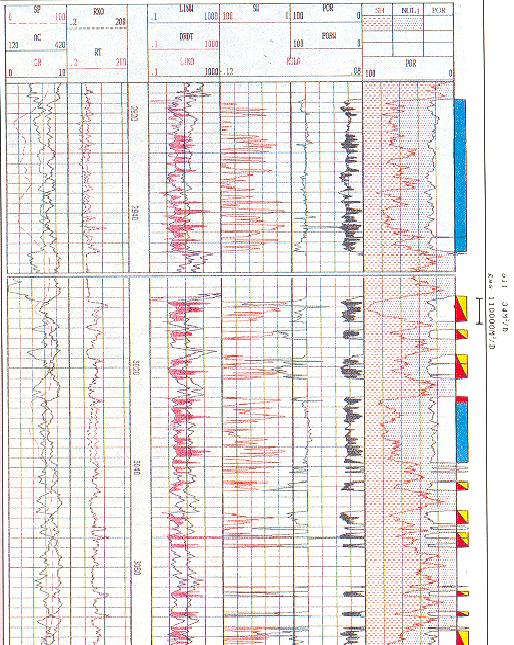
LOGDIGI Well Log Technology helped producer to find the great reserve in the Giddings Oil & Gas Field. (see logdigi well log analysis result)
This technology is different from conventional well-logging interpretation methods that usually use absolute concepts. The conventional methods are all based on an approximate value in designing of well-logging equipments, result measurements, data collection and data processing. Facing the extremely complex lithologies, it is very necessary to design well-logging evolution methods and programs and to find out the most excellent experiences in each area based on changes of objective conditions. Thus, the conventional methods are often affected by different lithologies, different regional conditions and well conditions, and they cannot be applied widely. But, our technique is quite different from that, which completely adopts relative concepts and rebuilds a strict lithologic conductive equation. The technique can automatically remove the influences of lithologic variations in different area and different depth. Meanwhile, it can also compensate complex conditions, such as influences of deep intrusion of mud filtrate in drilling with saline mud and influences of oil layer floodout after flooding, and automatically find out whether or not the parameters are accordant with actual situations. Consequently, our technology can be applied in any oil/gas fields and any region in the world.
LOGDIGI is a relative value curve of the producing capacity of oil and gas. LOGDIGI value, the bigger, the better. This technology is our propriety technology, it help our engineer determine whether or not this zone can produce high or not produce or little produce. The common technologies do not have this feature. For example, an oil/gas zone with high oil saturation, LOGDIGI is low. It tells our engineer; this zone could be heavy oil or due to tight formation and low permeability. See our successful example So_LOGDIGI_CASE 1, 1-2
Successful case:So_LOGDIGI_CASE1: this well is penetrating carbonate rocks. Processing by our software discovered an oil-bearing layer with So >50~80% and high value of LOGDIGI. The initial oil production of the pay was 2100M3/Day.
SO_LOGDIGI_CASE 1-2: This well is at the same structure as well SO_LOGDIGI_CASE 1, penetrating carbonate rocks. This interval, however, is determined as the dry because the processed by our technology found its So was larger than 60%, but LOGDIGI was very small.
What Makes Our Process More
Accurate
LogDigi technology completely adopts relative concepts and
rebuilds a strict lithologic conductive equation. LogDigi technology
is significantly improved well log analysis technology and different
from current well-logging interpretation methods that use absolute
concepts.
Traditional technologies are all based on an approximate value in
the designing of well-logging equipment, result measurements, data
collection and data processing. When facing extremely complex
lithology, it is necessary to design models in each area based on
changes in objective conditions. Traditional technology does not
adapt based on changes of objective conditions. Traditional
technology is often affected by different lithological, regional,
and well conditions. Traditional technology cannot accurately locate
oil and gas zones with complex lithology.
LogDigi technology has changed the current technology model of
evaluating quantitative oil/gas formations. This technology is a
breakthrough in well-logging technology, and an innovative method
for the discovery of new oil and gas zones. LogDigi technology can
automatically remove the influences of lithology variations in
different areas and different depths. It can also compensate complex
conditions, such as influences of deep intrusion of mud filtrate in
drilling with saline mud. LogDigi method also evaluates the
influences of oil layer flood out and automatically finds out
whether or not the parameters are accordant with actual situations.
This allows us to locate oil and gas zones 90% and greater. log
evalution for porosity, saturation, effective thickness of reservoir
beds. This plot is one of the successful samples. Contact us
for detail.
Our
successful case study 2
1) presentation
(ppt)
2) well log
analysis plot
Our
successful case study 3
1) report
2) result
3) well log analysis plot 1,
plot
2, plot
3
90%
old oil wells do not have Nuclear and Sonic logging. For many oil
companies, in order to re-exame their oil fields, they have to sent
down sophisticated nuclear, and acoustic tools on a wire-line for
the well. It costs them a lot to do that.
We re-evalute your oil fields with your existing logs. We do not
need "many times costly core sample taken from the well", and
"sophisticated nuclear, and acoustic tools are sent down the well on
a wire-line". What we need just gamma ray (or SP),and resistivity.
We can match your budget to re-evaluate your oil fields.
We determine the fluid and pressure distributions throughout the
reservoir, the natural energy sources available, and the methods
most useful in recovering the maximum amount of oil or gas from the
reservoir.
We analyze, interpret, and optimize the performance of
individual wells. We decides if it is economically feasible to make
the investment needed to produce the well. If it is, the production
engineer is given the tasks to determined how to bring this valuable
fluid to the surface.
We analyze data to locate drilling sites where oil and gas may
have accumulated in commercial quantities.
|