|
Significant hydrocarbon accumulations are ‘hidden’ in low resistivity, low contrast (LRLC)
sands in many of the world’s basins. LRLC reservoirs are found in several clastic basins
including ones in Argentina, Australia, Gulf of Mexico, India, Indonesia, Italy, Malaysia,
Nigeria, North Sea, Philippines and Venezuela. The Gulf of Mexico (GOM) basin is the
world’s leading oil and gas producer from LRLC clastic intervals. Many GOM fields have
produced for more than 20 years; some for more than 45 years.
Causes of LRLC pay include clean sands interbedded with shales, silts or shaly sands;
clay-coated sands; glauconitic sands; sands with interstitial dispersed clay; sands with
disseminated pyrite or other conducive minerals; sands with clay-lined burrows; clay clasts;
altered volcanic/feldspatic framework grains; and very fine-grained sand with very saline
water. LRLC depositional systems include: deepwater fans, with levee-channel complexes;
delta front and toe deposits; shingle turbidites; and alluvial and deltaic channel fills.
Useful geological and petrophysical models for evaluation of LRLC pay include the Archie
clean sand model with appropriate ‘m’ and ‘n’ values or Waxman-Smits shaly sand model.
LRLC typically have very high irreducible water saturation. The Archie lithology exponent
(m) and saturation exponent (n) for many LRLC reservoirs range from 1.4 to 1.85, and 1.2
to 1.8 respectively. Some shaly sand models are not suited for LRLC evaluation. -- Robert M. Sneider1 (1) Robert M. Sneider Exploration, Inc, Houston, TX
Developing low resistivity pay with existing old log data makes our technique unique.
Accuracy, economy and high return are the keys of our technique. Investors will also focus on them, right? Click to see more examples.
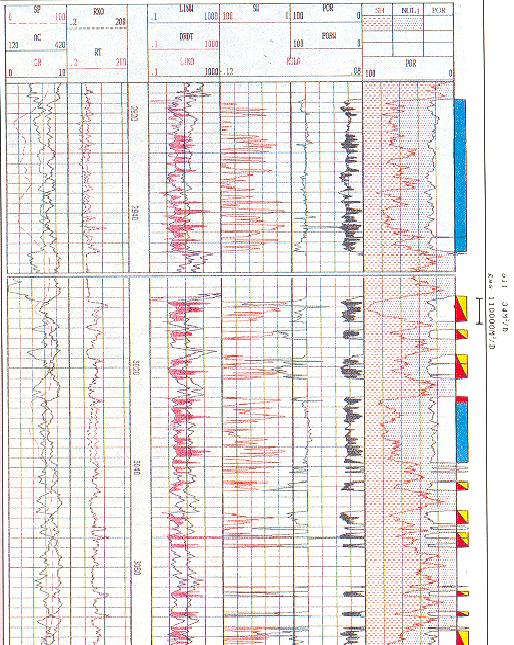
The following log is processed by our Low resistivity Low contrast (LRLC) well log technology.
Comment from Bureau of Economic Geology in 1995
Thank you very much for the demonstration of your new log analysis software on June 12 and 13, 1995. The software based on the derivative techniques is really good for evaluating a variety of sandstone reservoirs, especially for those with extremely low resistivities. I think that your software has the potential to become a very popular log analysis package. I would really like to see further development in your software in the near future. ---- Bureau of Economic Geology
What Makes Our Process More
Accurate
LogDigi technology completely adopts relative concepts and
rebuilds a strict lithologic conductive equation. LogDigi technology
is significantly improved well log analysis technology and different
from current well-logging interpretation methods that use absolute
concepts.
Traditional technologies are all based on an approximate value in
the designing of well-logging equipment, result measurements, data
collection and data processing. When facing extremely complex
lithology, it is necessary to design models in each area based on
changes in objective conditions. Traditional technology does not
adapt based on changes of objective conditions. Traditional
technology is often affected by different lithological, regional,
and well conditions. Traditional technology cannot accurately locate
oil and gas zones with complex lithology.
LogDigi technology has changed the current technology model of
evaluating quantitative oil/gas formations. This technology is a
breakthrough in well-logging technology, and an innovative method
for the discovery of new oil and gas zones. LogDigi technology can
automatically remove the influences of lithology variations in
different areas and different depths. It can also compensate complex
conditions, such as influences of deep intrusion of mud filtrate in
drilling with saline mud. LogDigi method also evaluates the
influences of oil layer flood out and automatically finds out
whether or not the parameters are accordant with actual situations.
This allows us to locate oil and gas zones 90% and greater. log
evalution for porosity, saturation, effective thickness of reservoir
beds. This plot is one of the successful samples. Contact us
for detail.
Our
successful case study 2
1) presentation
(ppt)
2) well log
analysis plot
Our
successful case study 3
1) report
2) result
3) well log analysis plot 1,
plot
2, plot
3
90%
old oil wells do not have Nuclear and Sonic logging. For many oil
companies, in order to re-exame their oil fields, they have to sent
down sophisticated nuclear, and acoustic tools on a wire-line for
the well. It costs them a lot to do that.
We re-evalute your oil fields with your existing logs. We do not
need "many times costly core sample taken from the well", and
"sophisticated nuclear, and acoustic tools are sent down the well on
a wire-line". What we need just gamma ray (or SP),and resistivity.
We can match your budget to re-evaluate your oil fields.
We determine the fluid and pressure distributions throughout the
reservoir, the natural energy sources available, and the methods
most useful in recovering the maximum amount of oil or gas from the
reservoir.
We analyze, interpret, and optimize the performance of
individual wells. We decides if it is economically feasible to make
the investment needed to produce the well. If it is, the production
engineer is given the tasks to determined how to bring this valuable
fluid to the surface.
We analyze data to locate drilling sites where oil and gas may
have accumulated in commercial quantities.
|